
Quick answer
A Texas bill doubles for two reasons at the same time. You used a lot more power. And your delivery charge went up with every extra unit you used. Switching plans only changes one half of the bill. The other half is set by your utility and is the same no matter who you buy from.
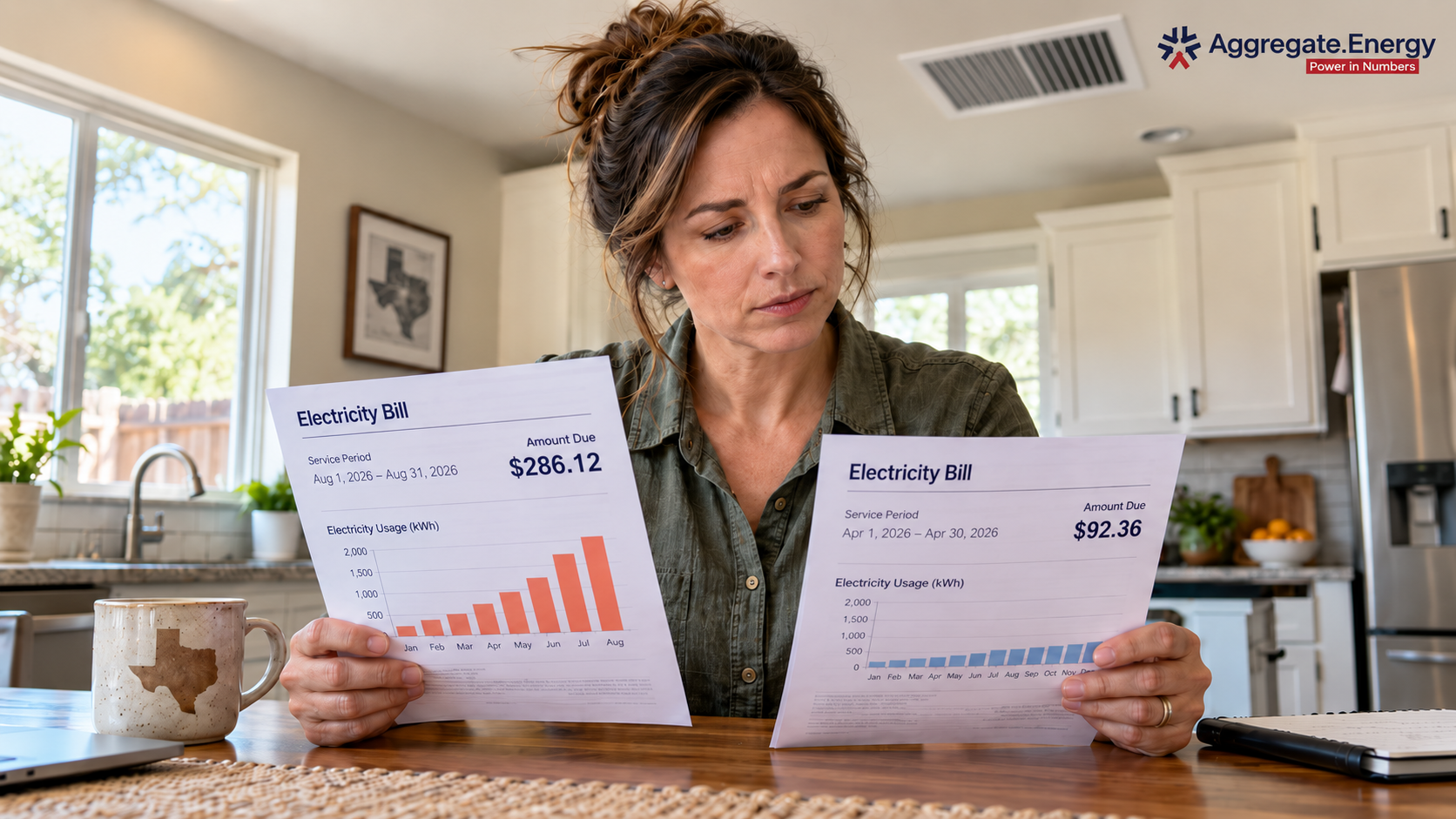
You changed nothing. The bill changed anyway.
You open the bill and it says $268. Last month said $141. Same house. Same thermostat. Same plan.
Nothing broke. Your bill is built from two different things, and both went up together.
Your bill has two halves
One half is the power. The other half is the delivery of that power to your house.
| Part of the bill | Who sets it | Can shopping change it? |
|---|---|---|
| Energy charge (the power itself) | Your electricity provider | Yes |
| Base or monthly fee | Your provider | Yes |
| Delivery charge per unit | Your utility: Oncor, CenterPoint, AEP Texas or TNMP | No |
| Utility fixed charges | Your utility | No |
| Taxes and city fees | State and city | No |
Your utility owns the poles, the wires and the meter. Your provider owns none of that. Switch providers and the same utility still delivers your power, at the same price.
Delivery is charged per unit. That is the part people miss.
Most people think delivery is a small flat fee. It is not. Most of it is charged per kilowatt-hour, just like the power.
So when your usage doubles, your delivery bill nearly doubles too.
The Public Utility Commission of Texas publishes what each utility charges. Here is the delivery cost at 1,000 kWh, as of 1 September 2026:
| Utility | Where it serves | Delivery at 1,000 kWh |
|---|---|---|
| AEP Texas North | Abilene, San Angelo | $59.93 |
| AEP Texas Central | Corpus Christi, Victoria | $61.07 |
| Oncor | Dallas, Fort Worth | $64.36 |
| CenterPoint | Houston area | $69.03 |
| TNMP | Gulf Coast, Lewisville | $81.87 |
Now picture a 2,000 kWh month in high summer. In Oncor territory, delivery alone passes $120 before you pay a cent for the power.
How much does summer really change?
More than most people think.
Across Texas, the average home used 819 kWh in March 2026 and 1,309 kWh in June 2026, according to U.S. Energy Information Administration data. In August 2025 the average was 1,522 kWh.
That is close to double, from a mild month to a hot one. Nothing about the plan changed. The air conditioner just ran. Homes with electric heat see the same pattern again during a hard winter week.
Try it on your own bills. Find the kWh number on a mild-month bill. Find it on your worst bill of the year. Most of the jump is right there.
Go line by line on your own bill
Pull out your last bill and find these.
- kWh used. The most important number on the page. Compare it to the same month last year, not to last month.
- Energy charge. Your rate times your usage. This is the part you shop for.
- Base charge. A flat fee some plans add every month. On a light month it quietly raises your real rate.
- Bill credit. Some plans only give this when your usage lands in a set range. Miss the range and you lose it.
- Delivery charges. A fixed piece plus a per-unit piece. Same for everyone at your address.
- Taxes and fees.
- Average price per kWh. What you really paid, all in. Compare this number, not the rate in the ad.
What you can change, and what you cannot
| You can change | You cannot change |
|---|---|
| Your energy rate | The delivery rate at your address |
| Your plan type, fees and credits | Which utility serves your street |
| How much power you use | That delivery grows with usage |
| When you lock a new rate | Utility rate updates twice a year |
If anyone says they can cut your delivery charge, they are wrong. The real levers are your rate, your plan type and your usage.
Why the bill creeps up even on a fixed plan
Utility delivery rates get reviewed by the state and usually change in March and September. Each change is small, often a fraction of a cent.
Over a year or two, those small changes add up. Your rate held. Your delivery did not.
Where we fit
Aggregate Energy works on the half of the bill that is open to competition. Homes join a buying group. The group goes to providers together, instead of each house being signed up one at a time.
That changes what a provider spends to get a customer. It does not change your delivery charge, and we will not pretend it does.
Want to see what is available at your address? Check your ZIP code. It takes a few seconds.
Frequently asked questions
Why did my bill double when my rate stayed the same?
Usage went up, and delivery charges went up with it. Compare kWh used, not dollars.
What is a TDU charge?
The fee your local utility charges to bring power to your home. The state sets it. Every provider passes it on at cost.
Can I lower delivery charges by switching providers?
No. It is tied to your address. Using less power is the only way to lower the total.
Is my meter wrong?
It is rare. Check your usage history first. If it still looks off, ask your utility for a meter test.
Which number should I compare between plans?
The all-in average price per kWh at the usage you actually have.