
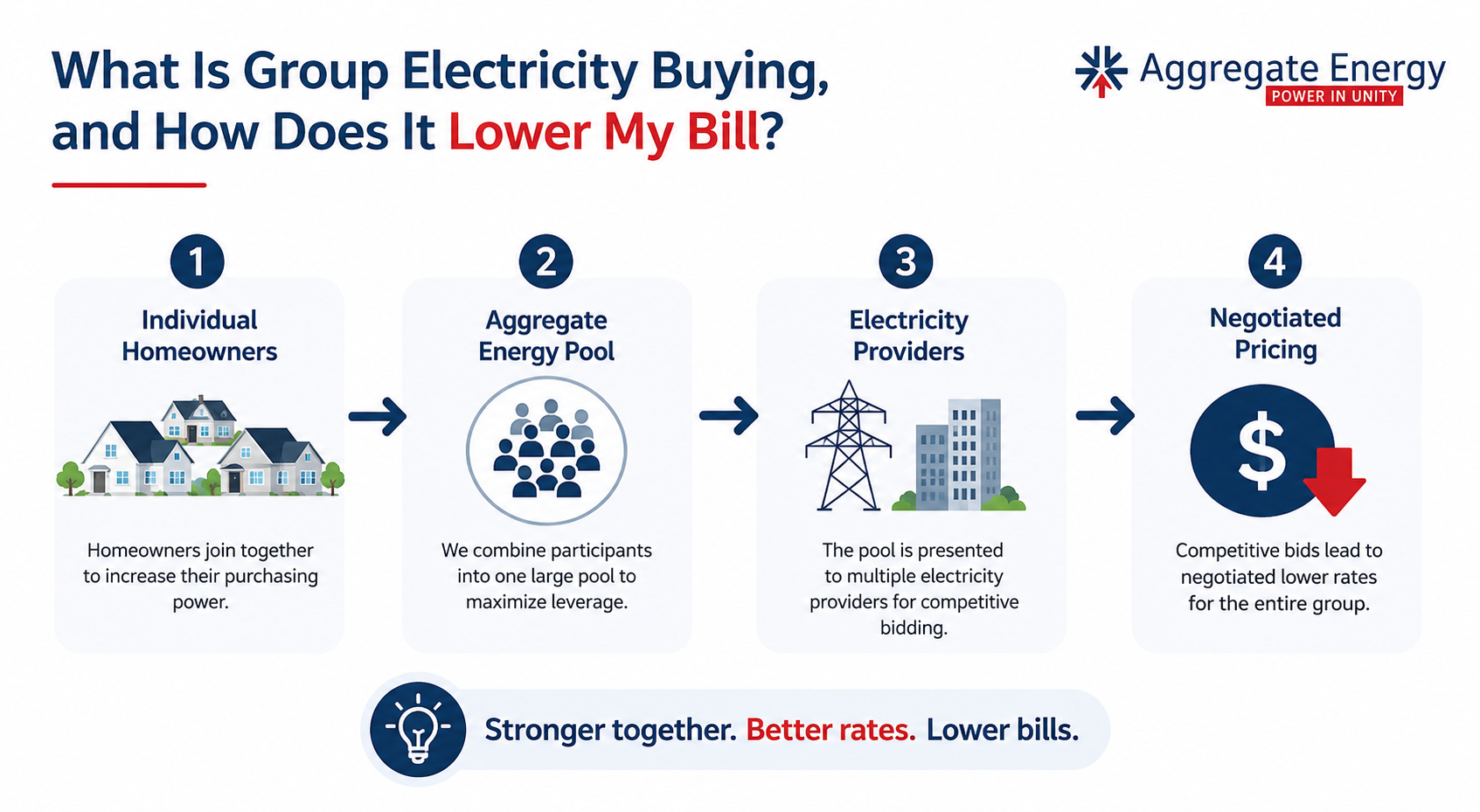
Simple flow of how group electricity buying works
Individual Homeowners → Aggregate Energy Pool → Electricity Providers → Negotiated Pricing
Electricity shopping in Texas is not as simple as it looks. On paper, it seems like you just compare plans and pick the cheapest one. But in reality, two similar homes in the same neighborhood can end up with completely different electricity bills.
One household might lock in a decent rate, while another may end up paying more simply because of timing, plan structure, or how providers price individual customers.
That’s not a mistake by the homeowner. It’s how a deregulated electricity market naturally works, pricing is built around individuals shopping alone.
Now imagine something different.
Instead of each home trying to figure it out alone, a group of households comes together and approaches electricity providers as one large, organized buying group.
That simple shift changes everything.
This is the foundation of group electricity buying in Texas, and it is the same model used by Aggregate Energy to help communities access more structured electricity opportunities.
Aggregate Energy operates on a demand aggregation model that connects households into structured electricity buying groups to improve pricing access.
Quick check: Check your ZIP code in seconds to see how Aggregate Energy group buying works in your area.
What Group Electricity Buying Actually Means in Texas
Let’s make this very real and simple.
Think about how most people shop for electricity. One household goes online, compares a few providers, checks rates, maybe looks at confusing charts, and eventually picks a plan that feels “safe enough.”
Now multiply that by 100 households doing the same thing separately.
Each one is treated as a small, individual customer in a massive competitive market.
Now flip the scenario.
Instead of 100 separate buyers, those 100 households are grouped together and presented as a single, coordinated demand block.
Now the electricity provider is no longer looking at small individual accounts. They are looking at a large, stable, and predictable customer base.
That is where group electricity buying becomes powerful.
It is not about changing electricity itself. It is about changing how buying power is structured.
One Homeowner vs 100 Homeowners: What Actually Changes
Imagine a homeowner in Texas sitting at their kitchen table late at night, scrolling through electricity plans. They’re comparing rates, reading fine print, trying to figure out what’s “good” and what’s not. In the end, they pick a plan that feels okay but there’s always a bit of uncertainty.
Now shift the scene.
Instead of one person, imagine 100 homeowners from the same area doing this together. Suddenly, the situation changes completely. The electricity provider is no longer dealing with one small account they’re looking at a large group of customers ready to join at once.
That shift alone changes the conversation. It’s no longer about convincing individuals one by one. It’s about offering a better structure for a large group that already exists. That’s where the real difference happens between shopping alone and group electricity buying, Texas style purchasing.
See what your neighborhood could save through group electricity buying in Texas programs.
One Homeowner Shopping Alone
A single homeowner in Houston or Dallas enters the market alone.
They see:
- multiple electricity plans
- different pricing structures
- usage-based conditions
- hidden fees or credits
They try to choose the “best” option, but they are still just one customer in a large system. Providers do not adjust pricing significantly for a single household because the business impact is limited.
So the result is usually standard retail pricing.
100 Homeowners Shopping Together
Now imagine 100 homeowners from the same region doing this together through a structured group.
From the provider’s perspective, this is a completely different opportunity.
Instead of:
- acquiring 100 separate customers
- spending marketing budget 100 times
- onboarding each account individually
They can acquire all 100 in one organized deal.
That reduces their cost per customer significantly and increases certainty of volume.
And when providers gain efficiency, they often have more flexibility in pricing structure.
This is the key mechanism behind group electricity buying in Texas programs and the model used by Aggregate Energy.
Why Electricity Providers Respond Differently to Groups
Electricity companies usually spend a significant amount of money acquiring customers. Between advertising, comparison platforms, promotions, and onboarding processes, each household typically requires separate effort and cost.
Now imagine removing that entire process.
Instead of attracting customers one by one, a provider is presented with a ready-made group of households all at once. No scattered outreach, no repeated marketing spend, and no individual onboarding efforts for every single account.
From their perspective, this is a very different opportunity.
It means they are no longer dealing with isolated customers but with a structured, predictable group of demand. That shift changes how they evaluate pricing and partnerships.
This is the kind of system Aggregate Energy is built around organizing household demand so providers can engage more efficiently at scale.
At a basic level, acquiring individual customers involves:
- advertising and marketing costs
- comparison platform fees
- promotional incentives
- administrative onboarding effort
When this process is repeated hundreds of times, it becomes expensive and inefficient.
But when households are grouped together, those efforts are consolidated into a single acquisition flow.
From a provider’s point of view, group-based demand offers three key advantages:
- lower cost to acquire each customer
- higher guaranteed volume in one deal
- reduced uncertainty in future demand
Because of this improved efficiency, providers are often able to structure more competitive and organized pricing options compared to traditional individual retail shopping.
Why This Idea Already Exists in Everyday Life
Group buying is already common in daily life. Wholesale clubs sell products cheaper in bulk because people buy together. Insurance works through shared risk pools. Employers negotiate health plans for entire teams instead of individuals. Even farmer cooperatives buy supplies in groups to reduce cost. Electricity follows the same logic when demand is combined, efficiency improves.
Wholesale Clubs
People pay lower prices because they buy in bulk as a group rather than individually. The store benefits from guaranteed volume, and customers benefit from lower per-unit cost.
Insurance Risk Pools
Insurance works because risk is shared across many people. Instead of pricing based on one person, it is spread across a group to stabilize cost.
Employer Health Plans
Companies negotiate healthcare coverage for employees as a group. This allows better pricing than an individual could access alone.
Buying Cooperatives
Farmers and small businesses often pool resources to purchase supplies in bulk, reducing overall cost.
Electricity works on the same principle. When demand is grouped, pricing efficiency improves.
How Group Electricity Buying Actually Impacts Your Bill

Here’s a simple way to picture it.
You’re still running the same AC, using the same fridge, and consuming the same amount of electricity. That part doesn’t change.
What changes is what happens before the bill is even created.
When households are grouped together, electricity providers look at a larger, more predictable block of demand. That reduces their cost of acquiring customers and managing individual accounts.
Instead of pricing each home separately in a highly competitive retail environment, they can structure pricing around a larger group agreement.
For a homeowner, this doesn’t mean guaranteed savings every time but it often means access to more structured pricing options that are not available when shopping alone.
When households are grouped together:
- providers reduce customer acquisition costs
- pricing becomes more competitive at scale
- retail markups can be reduced or restructured
- group-specific plans may become available
So the impact is not on usage, but on pricing structure.
That is why group models can sometimes result in more favorable billing outcomes compared to individual retail shopping.
A Realistic Look at Savings in Texas
It’s important to stay practical here.
Savings from group electricity buying are not fixed or guaranteed because electricity pricing depends on multiple factors.
For example:
A small apartment with low usage may see modest differences depending on the plan structure.
A large home with higher consumption may experience more noticeable changes.
Market timing and seasonal demand also play a role.
So instead of thinking of it as a fixed discount, it is more accurate to see it as access to better-negotiated pricing opportunities that are not typically available when shopping alone.
How This Works in Practice Through Aggregate Energy
Here is what actually happens in a real-world flow.
Households join a community electricity buying group through Aggregate Energy.
Their demand is combined into a structured pool representing collective consumption.
Electricity providers then evaluate this group as a single large opportunity rather than multiple small accounts.
Based on that, they present pricing options designed for that volume.
Households then choose from structured plans that reflect collective buying power rather than individual negotiation.
Common Concerns People Usually Have
When people first hear about group electricity buying, they usually pause and ask the same thing: “Is this actually safe or just another complicated plan?”
That reaction is completely normal.
The reality is much simpler than it sounds. Your electricity doesn’t change at all. The power still comes through the same local utility lines, the same infrastructure, and the same physical delivery system.
Another common concern is whether someone gets locked into a group permanently. In most cases, participation is structured with flexibility, not restriction.
And then there’s the question of fees. People assume there must be hidden costs somewhere but that depends entirely on how the program is designed. The important part is transparency, which is clearly defined before joining.
So instead of changing how electricity works, group buying simply changes how people access pricing in the first place.
Is this legitimate?
Yes. Group buying is a well-established model used across multiple industries, adapted for electricity markets.
Will I be locked into a group forever?
No. Participation is generally designed with flexibility depending on the program structure.
Does my electricity service change?
No. Electricity delivery remains exactly the same through your local utility infrastructure.
Does my utility company change?
No. Your utility still handles physical delivery and maintenance.
Are there participation fees?
This depends on the program, but many models are designed to keep participation simple and transparent.
Why More Texans Are Paying Attention to This Model
Electricity in Texas has become more complex over time, especially with multiple providers, fluctuating rates, and usage-based pricing structures.
Many households feel overwhelmed when comparing plans because small differences in terms can lead to large differences in monthly bills.
Group electricity buying is gaining attention because it simplifies this process.
Instead of dozens of separate decisions, households participate in a coordinated structure that focuses on collective negotiation rather than individual guesswork.
Final Thoughts
At its core, group electricity buying is not about changing how electricity is delivered.
It is about changing how electricity is purchased.
When households stop negotiating alone and start negotiating together, the entire pricing dynamic shifts.
That is the foundation behind Aggregate Energy helping communities unlock the power of collective electricity purchasing to create more structured and efficient outcomes.
Check your ZIP code today and see how joining a community electricity buying group through Aggregate Energy can help you access more structured and competitive electricity options in your area.
FAQs
What is group electricity buying in Texas?
It is a system where multiple households combine their electricity demand to access more structured and competitive pricing options.
How does group electricity buying lower my bill?
It improves provider efficiency and reduces acquisition costs, which can lead to more competitive pricing structures.
Is it available in my area?
It depends on whether your location is part of a deregulated electricity market in Texas.
Can I leave a group buying program?
Most programs are designed with flexibility depending on structure and terms.
Is it better than comparing plans alone?
It depends on whether you prefer simplicity or detailed individual comparison and control.
Why do providers support group buying?
Because it reduces customer acquisition costs and improves enrollment efficiency.