
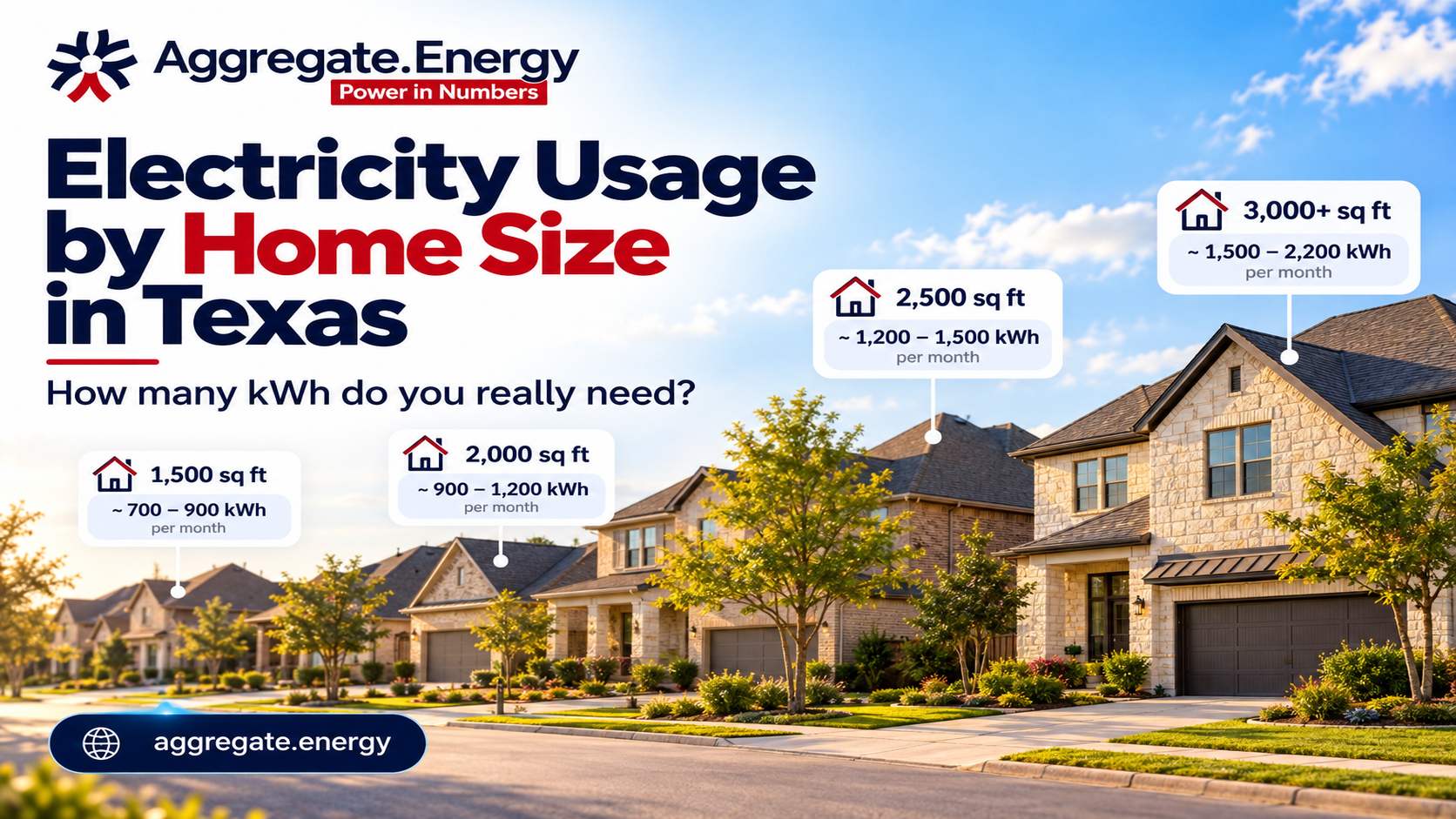
Quick answer
With no history to work from, estimate by home type and then widen for summer. A Texas apartment typically runs a few hundred kWh a month, a mid-sized house runs around four figures, and any home with a pool, an electric vehicle or electric heat sits well above its size class. Use the estimate to pick a short plan, not a long one.
Why an estimate is the wrong basis for a two-year contract
Estimates get you a plan. Real data gets you the right plan.
If you are moving into a home with no usage history, you are guessing at the one number every plan is priced against. That is unavoidable for a few months. What you can avoid is locking into 24 months on the strength of that guess.
Start with the Texas baseline
Across all Texas homes, the average was 819 kWh in March 2026 and 1,309 kWh in June 2026, climbing to 1,522 kWh in August 2025, per U.S. Energy Information Administration data.
Two things to take from that:
- Texas households sit above the national average, mostly because of air conditioning.
- The gap between a mild month and a peak month is close to double, before any plan or rate enters the picture.
Any single-number estimate you are given is a point on that curve, not a flat line.
Estimate by home type
Use this as a starting bracket, then adjust for the factors below. These are planning ranges for a mild month, not predictions of your bill.
| Home type | Mild-month range | What pushes it up |
|---|---|---|
| Studio or one-bed apartment | Low hundreds of kWh | West-facing windows, electric water heater, someone home all day |
| Two-bed apartment or small townhouse | Mid hundreds | More occupants, more appliances running at once |
| Three-bed house up to about 2,000 sq ft | Around four figures | Older insulation, ducted AC, a second fridge or freezer |
| Four-bed or larger house | Above four figures | Two AC units, high ceilings, a garage fridge |
Multiply the mild-month figure by roughly 1.7 to 2 for a peak summer month in most of Texas. That is the range you actually need a plan to handle.
Adjust for the things that dominate
Home size matters less than people assume. These matter more.
| Factor | Typical effect |
|---|---|
| Pool pump | A significant monthly addition, running year-round |
| Electric vehicle charging | Adds a large, predictable overnight block |
| Electric resistance heat | Turns a mild Texas winter month into a second summer during a cold snap |
| Working from home | Daytime AC load, which is the expensive load |
| Age of the AC unit and insulation | Two identical houses can differ by a third on this alone |
| Electric vs gas water heating and cooking | Gas shifts load off your electricity bill entirely |
If two or more of these apply, estimate at the top of your bracket rather than the middle.
What to do with the estimate
- Pick your bracket and write down a mild-month and a peak-month figure.
- Check plans at both numbers, using the prices disclosed at 500, 1,000 and 2,000 kWh.
- Avoid credit-dependent plans while you are estimating. A bill credit that needs you to cross a usage threshold is a bet you cannot price yet.
- Keep the term short. Twelve months or less until you have real data.
- Diarise a review for when you have twelve months of history, then shop properly.
The six-month correction
Once you have been in the home through a summer, your estimate stops mattering. Pull your actual usage, note your highest and lowest months, and price plans against your own year.
That is the moment most households quietly overpay, because the estimate-era plan rolls on untouched. Set the reminder now.
Aggregate Energy handles that cycle for the group rather than leaving it on one person’s calendar. When you have real numbers for your new address, checking your ZIP code takes a few seconds.
Frequently asked questions
How many kWh does a Texas house use per month?
It depends on size, features and season. Statewide, the average home used 819 kWh in March 2026 and 1,309 kWh in June 2026.
How much electricity does an apartment use?
Usually a few hundred kWh in a mild month, rising substantially in summer. Occupancy pattern matters more than floor area.
Can I estimate from square footage?
As a rough bracket, yes. Pool, EV charging, electric heat and AC age move the number more than floor area does.
Should I sign a long contract based on an estimate?
No. Keep it short until you have twelve months of real usage.
How do I get real usage later?
From your provider’s online account, your bills, or Smart Meter Texas.